Example app for surgical practices

Voice AI intake for surgical clinics, governed by the CarePlan.

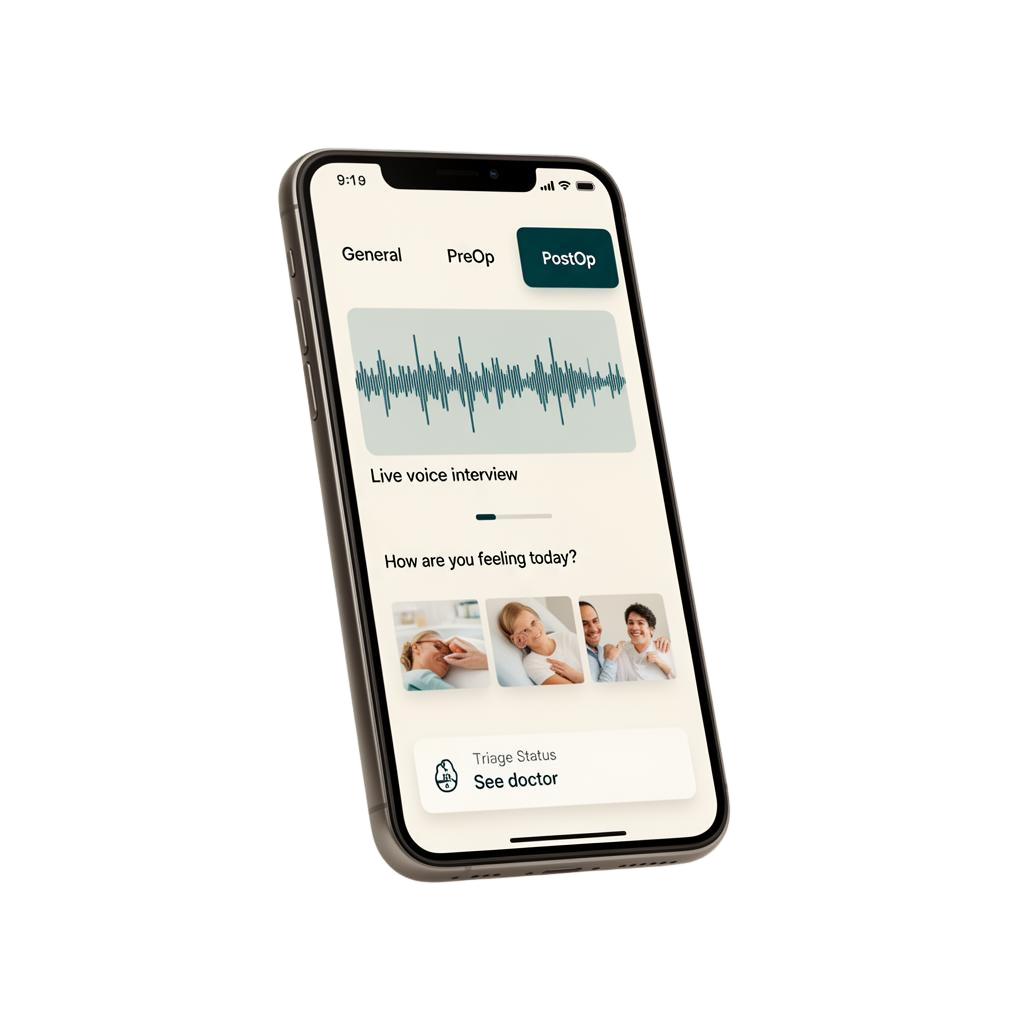
Triager guides the patient through voice check-ins, photo capture, symptom review, and checklist confirmations. Rounds gives the clinical team the same CarePlan state: what was assigned, what was completed, what needs verification, and what should escalate.
CarePlan
evidence loop
InVivo
optional packets
Android
parity path
ProvidEHR
record boundary
Triager mobile app showing General, PreOp and PostOp workflows with live voice interview, photo uploads and triage status
Now implemented

The CarePlan stack is now concrete enough to explain.

These are product proof points, not medical claims: consent-scoped evidence, patient voice and photo capture, clinician verification, governed record boundaries and Android parity.

CarePlan evidence needs

Triager can list due, overdue, missing and review-required evidence needs before asking the patient for the next step.

Voice and photo completion

Patients can report allowed activity completion by voice and attach photo metadata with consent and clinician-review state.

Optional InVivo evidence

When connected, InVivo can supply patient-owned Clinician Packet evidence with included, withheld, stale and missing states.

Rounds verification

Rounds keeps patient-reported status separate from clinician verification, documentation drafts and export decisions.

ProvidEHR boundary

ProvidEHR can host workflow records while orders, legal-record writes and CarePlan mutations stay behind explicit review authority.

Cross-platform parity

The iOS/macOS workflow is paired with Android CarePlan parity for evidence, consent, audit and claim-boundary behavior.

The problem

Patient intake is still too manual for modern surgical practices.

Across pre-op, post-op and general follow-up, the same gaps show up — and they fall on clinic staff to close.

Incomplete intake forms

Staff spend time chasing missing details and unclear symptom descriptions.

Scattered post-op signals

Recovery concerns arrive as unstructured calls, texts and photos.

Surgeons need concise context

Clinicians want a clear picture before deciding what requires attention.

Patients want a calmer flow

A guided way to report symptoms and recovery concerns at their own pace.

The solution

Structured intake, guided by voice.

A focused set of capabilities that turn an unstructured conversation into a clinician-ready handoff.

Realtime voice interview

Asks one clear question at a time, adapting to the patient's answers.

General symptom triage

Collects basics, symptoms, body regions and red flags into a structured record.

Pre-op baseline intake

Captures planned procedure, timing, operation area and baseline photos.

Post-op recovery check

How the patient feels, procedure date, symptoms and current recovery photos.

CarePlan checklist

Turns pre-op preparation, wound care, medication, diet and activity instructions into reviewable tasks.

Rounds clinician view

Shows completion, missed steps, patient-reported evidence and items requiring clinician verification.

Photo-aware workflow

Photos are used as visual context for clinicians, never as standalone diagnosis.

Deterministic triage floor

Rules-based urgency output: self-care, see doctor, urgent or emergency.

Clinician handoff

Structured summary, red flags, photo metadata, transcript and tool-call audit trail.

Surgical workflows

Built for visual surgical follow-up, starting with breast reconstruction.

Triager and Rounds are strongest when recovery is longitudinal and visual: incisions, swelling, bruising, drainage, wound edges, skin color, implants, flaps, activity restrictions, diet, medication adherence and patient distress all matter.

General

Symptom intake

Structured symptom intake with optional photo requests when visual context helps.

  • Body region mapping
  • Onset & severity
  • Red flag screening
PreOp

Baseline before surgery

Baseline photos and procedure context captured before the operation date.

  • Planned procedure
  • Operation area
  • Baseline photo set
PostOp

Recovery check-ins

Recovery check-ins with red flag screening and photo-guided context.

  • Day-since-procedure
  • Symptom delta
  • Current photo set
CarePlan first

The CarePlan is the shared operational object.

This is not a static discharge PDF. A FHIR-shaped CarePlan governs what the patient is asked to do, what the clinic expects to verify, what Rounds prioritizes, and what ProvidEHR records.

Pathway template

A generic surgical pathway defines phases, tasks, questionnaires, reminders, visibility rules and escalation thresholds.

Patient-specific CarePlan

The pathway is instantiated for one patient with dates, responsible teams, assigned activities and procedure-specific instructions.

Voice completion

The patient can confirm low-risk activities by voice, such as diet adherence, symptom checks, medication taken, or incision care completed as instructed.

Clinician verification

Rounds separates patient-reported completion from clinician-verified status so the care team can review evidence and override safely.

Breast reconstruction pathway

CarePlan checklist

Active
Pre-opPatient confirmed

Fasting instructions acknowledged

Post-opNeeds review

Incision care completed as instructed

DietIn range

Protein target logged

MedicationOn schedule

Antibiotic dose reported

PhotosAttached

Day 5 recovery photos uploaded

Patient-reported events stay visible as patient-reported. Rounds can ask the clinician to verify, accept, request more information, or escalate.

Record strategy

Triager and Rounds work standalone, but ProvidEHR makes them clinical infrastructure.

For a clinic without a suitable system of record, ProvidEHR can hold the structured patient record. When the clinic already has an EHR, ProvidEHR acts as the governed workflow and clinical data layer, with treatment decisions and orders remaining in the connected EHR unless ProvidEHR is explicitly deployed as the legal record.

Triager

Patient-facing voice, photo and checklist interaction. It gathers CarePlan evidence and urgent signals without claiming to diagnose.

Rounds

Clinician-facing queue and case review. It shows CarePlan compliance, exceptions, transcript context and verification needs.

ProvidEHR

Structured record substrate for CarePlans, Rounds cases, audit trails, delegated MCP access and external EHR synchronization.

Agent-accessible, governed records

MCP and platform intents use delegated scopes and audit trails.

The same CarePlan state can be available to approved agents for reading, summarizing and low-risk patient-reported check-off. Higher-risk clinical writes, orders and disclosures remain clinician-approved workflows.

Safety model

AI conversation. Deterministic triage. Clinician review.

Triager is an intake support tool. It does not diagnose, treat or prescribe, and it is not a substitute for clinician judgement.

AI collects & clarifies

Conversational intake gathers information and asks follow-ups.

Deterministic triage

Urgency comes from rules and validated screeners — not the model.

Emergency red flags

Specific flags can trigger clear escalation guidance.

Clinician in control

Your team owns review, follow-up and any clinical decision.

CarePlan provenance

Assigned tasks, patient-reported completion and clinician verification are distinguished.

Clear provenance

Patient answers, image context, AI text and rules outputs are distinguished.

Clinic branding

A patient experience that can feel like your practice.

Clinics can configure the intake experience and, where authorized and consented, support a doctor-branded voice experience with a standard fallback voice.

  • Explicit doctor authorization
  • Patient disclosure
  • Clinic-controlled use
  • Audit logging
  • Fallback voice when unavailable
AR

Dr. A. Reyes

Plastic & Reconstructive Surgery

Branded voice

Hi, this is Dr. Reyes' clinic. I'll guide you through a quick recovery check today.

Authorization

Signed by doctor

Patient disclosure

Shown on session start

Privacy-ready architecture

Designed for sensitive clinical workflows.

Triager is designed to support clinic compliance workflows. It is positioned to fit into your existing privacy program — not to replace it.

Granular consent

Microphone, AI-assisted intake and photo upload are each explicitly consented.

Secure handling

Audio, transcripts, photos and structured intake data are handled with care.

Role-based access

Clinics control who on the team can see what, per role.

Configurable retention

Set retention policies that match clinic and regional requirements.

Audit logs

Sessions, tool calls and access events are logged for review.

Short-lived realtime tokens

Backend-issued, short-lived credentials for production realtime sessions.

Clinician handoff

The Rounds view shows CarePlan status, evidence and triage in one place.

A single, structured panel: assigned tasks, patient-reported answers, photos, deterministic triage, clinician verification state and the full audit trail.

Session #PT-2841
Triage floor: See doctor
Entry point
PostOp
Pathway
Breast reconstruction
Date
5 days ago
CarePlan
9 of 12 tasks complete
Photos
3 uploaded
Verification
2 items need review

Summary

Post-op day 5. Patient reports moderate swelling and bruising, mild pain 3/10, no fever and no shortness of breath. Incision care was marked complete by the patient; Rounds asks the clinician to verify photos and drain-output notes.

self-care
see doctor
urgent
Audit trail · transcript · tool eventsOpen

Give patients a governed way to follow the plan. Give clinicians the evidence to act.

See how Triager, Rounds and ProvidEHR can support a CarePlan-guided surgical pathway.